Jitarth Jandeja: “Anderson, I thought you did that. And I would like to apologize for that right now. So I apologize for thinking you ate babies.”
Anderson Cooper: I’ve tried to engage sometimes with some of them who contact me, and there’s no rational way to prove you haven’t committed a crime.
Jandeja: There’s nothing you can say, whatever you do or don’t do will be more proof of your guilt. But the thing is, this isn’t really about you, in their mind. This is about them, this is about their internal fears, their internal projections, their internal lack of control over their own life. (TMZ, 2021)
Hannah Arendt’s 1951 book, The Origins of Totalitarianism provides insight to the socio-political factors that produce a totalitarian movement as witnessed during Nazi Germany and the Soviet Union’s Bolshevik regime. While the book provides a larger argument about the role of antisemitism, racism and imperialism as both required and fundamentally different from totalitarianism, it is Arendt’s chapter on Ideology and Terror that seems most pertinent to our American state of affairs today, especially of the QAnon movement that emerged from the depths of the interweb.
Arendt posits that loneliness, different from isolation or solitude, provides the common ground for a grooming through terror and ideological logicality. “But totalitarian domination as a form of government is new in that it is not content with this isolation and destroys private life as well. It bases itself on loneliness, on the experience of not belonging to the world at all, which is among the most radical and desperate experiences of man. (p. 475).
Bryan Brayboy and company’s (2012) chapter on Critical Indigenous Research Methodologies (CIRM), which argues that Western prioritization of objectivity, method and singular Truth “has functionally served to vivisect the world, cutting across interconnections, lives, cultural knowledge, and bodies…Such dissections leave the objects of research scarred, producing and reproducing knowledge that defines the borders of exclusion and projects denigrated caricatures of the other to be internalized as grotesque truths about one’s own being and community (p. 429). Here, I imagine colonization as shears, extracting material resources and bodies, while cutting apart networks – the colonizer needing to cut boundaries and rationalize the Other, but in so doing, isolating, and then disconnecting themselves.
Colonization and its economic enactments as capitalism and neoliberalism have created “a world whose chief values are dictated by labor…only the effort to keep alive,” and thus have cut away and sold our own identities. In a finite world, we eventually extracted and sold ourselves.
Arendt seems to offer hope, in the recognition of the freedom inherent in thought and political action, in rebirthing ourselves as individuals and not One, in reclaiming our truths as localized and not universal, in ensuring we are human and not animal. This reclaiming of humanity, of our individual identities within the masses, while an avoidance of total domination, may only offer a continuation of our plight. Are we fighting domination with the tools of domination?
If “totalitarian domination, like tyranny, bears the germs of its own destruction,” might our current state of affairs be similar? Are Donald Trump, and his mass Qanon and other loyalists, the inevitable product of a colonial turned neoliberal market? Is thought and action, especially thought and action rooted in Western individualism, enough to reclaim identities and reconnect lost souls? Ultimately, does democracy unbind us from this present course – or might it also, fall short? What even is democracy if not a market for the masses?
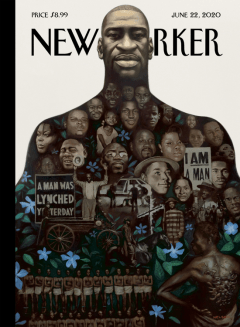
This first week of February marks Black Lives Matter at School, a national week of action dedicated to organizing for racial justice in education. In this pandemic year, COVID has highlighted and exacerbated existing inequities, negatively impacting the mental and physical health, economic well-being, and access to education of Black, Indigenous, and people of color at higher rates than white Americans. Simultaneously, this summer’s state-sanctioned murders of George Floyd, Elijah McClain, Brionna Taylor, and others, increased the attention and acknowledgment of systems of white supremacy, oppression, and privilege AND the entrenchment of white nationalism and white supremacy within our American institutions. Following are some preliminary thoughts about the role of organized movements such as Black Lives Matter at School as counter-project to neoliberalism. More importantly than anything I write, please click the link above and spend time with the curriculum, demands, and 13 guiding principles. Consider committing to the Year of Purpose and sharing these resources with educators and students in your life.
In her 2018 article “Pasarse PolÍticamente: Interrupting Neoliberal Temporality,” RocÍo Zambrana uses Walter Benjamin’s notion of Entsetzung to explore the interruptive nature of Rebollo-Gil’s pasarse polÍticamente, hopeful acts of “offensive” protest that expose race, gender, and class hierarchies and the ways the debts of capitalism bind subjects and therefore disallow freedom. Entsetzung, subverts “colonial, patriarchal, slow, and punishing” laws and practices through refusal of the institutional logics they conserve, namely open markets of domination. Recognizing “the master’s tools will never dismantle the master’s house (Lorde, 1984, pg 2)”, these acts depose rather than oppose, afform rather than reform. They rip open and expose the guilt-debt nexus, they break the binds that maintain the status quo and they offer means to new collectively built futures. “These protests work within debt history, through the history of debt, in hopes of a new history.” (Zambrana, 2018, pg 111)
#BlackLivesMatter crosses the discursive boundaries of white American racialization. Colin Kapernick’s kneel refuses patriotic appeals. Minneapolis small business owners impacted by fires and virus choose mutual aid over profits, making space for raw Black anger. Indigenous, queer, trans, and Black communities communicate commitments of solidarity and emancipation. Within and through these examples, abolition, self-determination, and liberation emerge.
During the national context of Trump and Trumpism, John Muir Elementary teachers in Seattle commit to wearing Black Lives Matter/We Stand Together t-shirts. Liberate. A white supremacist calls a bomb threat. Protect. This galvanizes the community and inspires city-wide action by Social Equity Educators (SEE) who put forth demands for ethnic studies, restorative practices, and detracking. Liberate. Police murder more unarmed Black men, women, and youth. Protect. Kapernick kneels, high school sports teams kneel, marching bands kneel. Liberate. Seattle Education Association, Seattle NAACP, Seattle Council Parent Teacher Student Association, and others join together in solidarity. Liberate. Black Students Matter. Liberate. Liberal white parents complain. Protect. Pregnant mother Charleena Lyles is murdered in her apartment and dehumanized by the media. Protect. More t-shirts, protests, now guiding principles, national attention, curriculum development, organized movement. Liberate.
Black Lives Matter at School and the larger Black Lives Matter collective serve as interruption and countermovement of neoliberalism. Through collective open source curricular development and organized action the movement refuses commodification of labor and, thus, ownership of leadership and responsibility. Through refusal of individualism and dominance, and recognition that this is a means and not an end, the movement exposes both violent and non-violent opposition as foreclosures of liberatory futures, thus inviting new membership in a collective reimagining of society where humanity, Black humanity specifically, cannot be sold.
Reflections upon reading Achille Mbembe’s Necropolitics, during a week of necropolitical actions.
When I created my blog, naming it EduSpeak was a commitment to myself to continue to process various readings through the lens of education. Enter(Mgembe’s Necropolitics), start(writer’s block). Hopefully at some point, I’ll connect the dots enough to revisit this piece and make the education connections more explicit.
Following, I offer zero made sense. Perhaps due to the timing of the reading – insurrection, pandemic, precarity and reading alongside Indigenous Methodologies and Sociological Imagination – and likely because I my vocabulary and conceptualizations of the philosophies of politics are still infantile – I spend much of this reading meditating on “disembodiment,” and “transfiguration.”
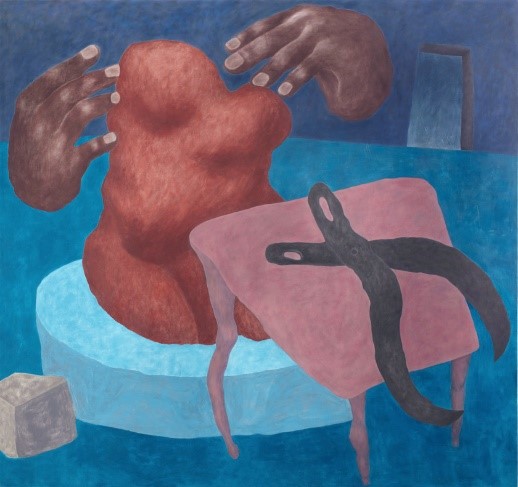
I’m hoping pictures are worth more than words, as my words have failed me this week.
Ginny Casey, Moody Blue Studio; 2017
In Mbembe’s conclusion, he discusses a project of transfiguration. As this was a new word for me, I Googled, and was surprised at the dominance of Western Christian ideology attached to the word. I wanted it to read: transfiguration (v): sewing together of mind, body, and spirit – individually and collectively. Mgembe offers: “Transfiguration demands that the subject consciously embrace the broken up part of its own life; that it compel itself to take detours and sometimes improbable connections; that it operates in the interstices if it cares about giving a common expression to things that we commonly dissociate.” Even better, his definition decolonizes disembodiment and individuality, through a process of embodied awareness of self as “fragment of humanity”, a moment in “never-ending time”, and as “compound of other living beings and other species, belong(ing) to all places together.” (2019, p. 187)
His ethics of passing from place to place, “weaving with each one of them a twofold relation of solidarity and detachment. This experience of presence and distance, of solidarity and detachment, but never of indifference,” (pg. 188) elicited Mills’ description of society as a “time of uneasiness and indifference—not yet formulated in such ways as to permit the work of reason and the play of sensibility. Instead of troubles—defined in terms of values and threats—there is often the misery of vague uneasiness; instead of explicit issues there is often merely the beat feeling that all is somehow not right.” (1959, pg. 11) Democracy built on violence, requires passivity, and ignorance.
Reflecting later, Gloria Anzaldua called and said, I told you this last week, “Nepantlera represents a type of threshold person or world traveler: someone who enters into and interacts with multiple, often conflicting, political/cultural/ideological/ethnic/etc. worlds and yet refuses to entirely adopt, belong to, or identify with any single belief, group, or location.” (Keating, 2012, p. 12)
And, Nanabush, Nishnaabeg Spiritual Being and teacher, said, “Me too.” (Simpson, 2017)
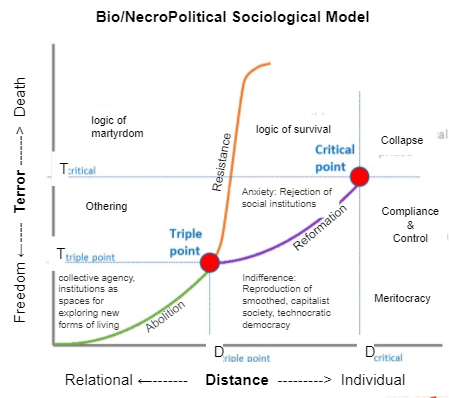
Then, the chemistry concept of phase changes jumped in my head and I spent four days searching liminality and thresholds and triple and critical point and trying to fit this to education and relationality and necropolitics and futurity. Along the way, I found this great example of speculative fiction about democratization (or not) of educational technology, and everyone should read it (Macgilchrist, 2019). The below is an attempted synthesis of that search.
Reflections on Lemert’s Introduction to Social Theory and Rose’s Public Education Under Siege.
I’d like to reflect today on Lemert’s definition of Social Theory as the practice of “telling one’s world into being,” or at least into the dominant public discourse. In relation to all three articles from Public Education Under Siege, it seems there is an important tension between a quantified telling and discursive wording of social phenomena, where in public education, quantification continues to dominate with those with decision making authority. Using Spencer’s quote (pg. 24), “One rationale for this arrangement was that American taxpayers should not reward schools with funds if those schools were not providing all kids with a quality education,” I’d like to reflect a bit on the words quality and accountability, and discuss an important connection to current educational policy and programming.
Quality education (n): standard as measured against other similar things; the degree of excellence or goodness of education. This word requires comparison to an ideal type. An ideal type, for those with power, is almost always the ideal type of dominant experience, dominant experience rarely recognizes non-dominant ways of knowing and being. In our neoliberal, capitalistic society, the ideal type either makes profits (easily quantifiable, easy to manage, focused on procedure, etc) or wields/maintains power (colonization/Western thought, positivist). This adjective begs us to ask: for and to whom this education is worthy? Data disparities answer this question; however, those doing the analysis, who believe in the ideal type, see lower scores as a lack of excellence, rather than narrowly defined excellence. Thus, quality (n): reproductive.
Accountability (n): counting, reckoning of money paid, return on investment, responsibility. **Responsibility (n): answerability. Thinking about the use of this word in terms of conversations about the measurement of teaching and learning makes me think about why our policies, mission statements, and political rhetoric insist a public discourse of counting rather than answering. Words matter.
One really important connection to these readings is the current emphasis of mental health and wellbeing and social emotional learning in Oregon’s Student Investment Account funding, policy that (I feel strongly) has huge potential to shift schools away from neoliberal, standardized approaches. Interestingly, there is no direct metric of accountability for supporting students’ mental and behavioral health, though through lines can be/are drawn to academic success, attendance, and graduation rates. Many districts, unfortunately, are moving towards use of DESSA, “a standardized, strength-based behavior rating scale completed in 5 to 8 minutes and used by educators and parents to measure the social-emotional competence for children.” Rooted in the same logic as standardized academic testing, quantification of individuals, especially through a dominant lens, may serve to reproduce an ideal student rather than create a school system that welcomes and celebrates the unique assets of every student. My team and I are committed to leading implementation and evaluation in our county that holds schools responsible for seeing all students’ excellence, rather than students accountable for conforming to school excellence.
Arizona Governor Doug Ducey’s 2021 State of the State Address: An algorithm for “Precarity Capitalism” despite a global pandemic
In her October 2020 article, Viral Insurgencies: Can Capitalism Survive COVID? Albena Azmanova diagnoses the underlying conditions of America’s economic and political systems. She outlines a political logic that serves as algorithm for the precaritization of society, “a state of economic and social insecurity that ails not just the most vulnerable…but the great majority, irrespectively of class, revenue, education, race or gender.” In this post, I use excerpts of Arizona Governor Doug Ducey’s January 11, 2020 State of the State Address as demonstration of Azamova’s code.
First, a reminder of context. This speech was given five days after the US Capitol insurrection, where proud Arizona public school graduate, and QAnon spokesperson Jake Chansley-Angeli – horned, half-naked, tattooed, and appropriating the dress of cultures that are not his own – was photographed playing Rocky on the Capitol dais and is believed to have left an ominous note for Vice-President Mike Pence. This was also one week after Arizona’s second COVID-19 wave made the state the world’s hottest transmission spot, when the virus took the life of the mom of my close childhood friend, one of 253 deaths in the state that day. And, this speech was given four days before Arizona recorded the world’s highest 7-day case rate for the second straight week. So I can try to remain focused on political theory and school reopening, I’ll share Ducey’s punchline here, “The critics can say what they want, but the path I’ve outlined is the right path for Arizona.” Clearly.
Democratic tools of violence.
Step 1: Political logics: Use democratic tools to promote profits over people.
“If there’s an upside to the unique circumstances, it’s that for this year’s address we have more people than ever watching us live from across the state. What we’ve lost in ceremony, we’ve gained in citizen engagement.”
In his 6th year as AZ Governor, Ducey’s priorities include Educational Excellence, 21st Century economy, Protecting our Communities, Fiscal Responsibility, and Happy & Healthy Citizens. His website explains the importance of “ensuring government regulations don’t prohibit or delay hardworking Arizonans from making a living,” his commitment to “being responsible with our budget, investing in the future, and allowing the people to keep more of the dollars they earn,” and the necessity of a “strong, innovative, economy” where healthy citizens have access to “clean water and lands to safely roam, work and play.” Here, he forgot to explain his commitment to school choice and privatization of public schools, choosing instead to remind readers that, “A great economy requires great public schools.”
In his address, Ducey only highlights economic factors in his response to, “Why not more and longer lockdowns? Why not more aggressive lockdowns? Schools, businesses, parks, weddings, funerals, church services – why not ban all gatherings and just lock everything down?
It’s a question that only makes sense if you forget about everything else – all the other troubles that lockdowns set in motion. The rest of life doesn’t stop in a pandemic, least of all our basic responsibilities. People still have bills to pay, children in need of schooling, businesses to run and employees who depend on them. There are lots of men and women who don’t have the option of remote work and don’t receive uninterrupted direct deposits. To make a living, they have to show up somewhere. And if the doors are closed, then at a certain point they are never going to open again.”
Forgetting, or ignoring, the fact that the government could choose to enact measures that protect Arizona’s most vulnerable citizens from eviction and foreclosure, and that those with the most money have profited during the pandemic, he explains, “If we’re really all in this together, then we have to appreciate that for many families “lockdown” doesn’t spell inconvenience; it spells catastrophe… zero income, inability to make a payment, eviction, foreclosure, and real personal anguish.”
Calling on Arizonan resilience and work ethic, he continues, “Our independent spirit, after all, is one reason why so many people feel drawn to Arizona. They see that spirit as well in our respect for hard-working taxpayers. And for Americans tired of living in states with high taxes, heavy regulation, low-growth, and fading opportunity, Arizona has become the destination.
And they’re still coming to Arizona in 2021 because during the pandemic, we never took our small businesses or their workers for granted. As bad as things got, we’re recovering fast. New businesses and residents have been added by the thousands. At this time last year, we were ahead of 45 other states in job creation and personal income growth. Today, we’re still top-five. But some Arizonans are struggling. And it’s got to be our priority to help them with a growing economy and more jobs.” The 11,248 struggling in their graves are encouraged by the prospect of new jobs. “My goal has been to make Arizona the best place in America to live, work, and do business – by letting Arizonans keep more of their hard-earned money. And having come this far, as other states chase away opportunity with their new taxes, why on earth would we ever want to follow their failed and depressing example?” One can only imagine.
Take Care of Yourself in the Always-on Economy
Step 2: Government shifts responsibility for social accountability to individuals.
Azmanova posits the notion of “socially irresponsible rule,” where leaders dismiss the negative long term impacts of their economic policy pursuits. From the environmental degradation of increased production and consumption to the deleterious effects on social support networks caused by an ever increasing competitive environment, leaders in “precarity capitalism” often dismantle social services because maintaining them in case of emergency is seen as too costly. Globalization traps both the employed winners and unemployed losers of “precarity capitalism” through “fear of physical insecurity, political disorder, cultural estrangement, and employment insecurity.” COVID-19 and the political pandemic response have exacerbated all four.
Perhaps because it resonates and perhaps as a reach across the aisle, Governor Ducey includes in his speech, a nod to neoliberalism’s “notion of individual self-reliance,” as he makes heroes out of essential workers while completely ignoring the failures of the public health system, especially for Black and Indigenous Arizonans.
“We’ve also had reminders – as if any were needed – of why medicine and nursing are so respected among life’s great callings. I think of Edmond Baker, a doctor and Army veteran who for years has cared for patients in the medically underserved parts of Arizona. Like so many other doctors, he has stayed on call and has never relented, so that no matter who you are or where you live, you can get the care you need.” You, too, can be a hero if you join the military and then participate in the always-on economy.
“Then there’s Regina Villa, a nurse at Valleywise Health Medical Center. The mission, says Nurse Villa, “is truly to care for all people. It doesn’t matter who you are.” It’s been a time when COVID patients can’t even see their families, and nurses can feel like the only friend at their side. Nurse Villa is one of the thousands who have met this crisis with courage, grace, and kindness.” And, you, young woman, just have to be kind.
“And we can never overlook the incredible service of the Arizona National Guard. Consider just the single example of Will Smith, a medic who in 2019 came home from deployment in Iraq. With the pandemic, Will found himself back in a Blackhawk helicopter delivering COVID testing kits to tribal nations. That was Will’s idea of a break from his regular job at Scottsdale Osborn Medical Center.” And, you, too, can drop swabs and bombs in the name of our great country!
COVID-19
AZ
WA
Population
7,424,805
7,656,200
Cases/100K Last 7 Days
121.6
32.6
Cases Last 7 Days
61,935
17,363
Total Cases
658,186
285,970
Cases/100K
9,043
3,755
Deaths/100K
151
51
Data from CDC website on Jan 14, 2021
Speaking of our great country, Ducey paints the social distancing and lockdowns as the root of substance abuse and suicide, forgetting to mention these were also endemic prior to the coronavirus. Interestingly, his website details public safety as the number one responsibility of governments (here I was starting to think it was the economy!) and highlights his “new investments in child safety, an enhanced partnership with local and federal law enforcement, and initiatives to combat human trafficking, drug smuggling, and the scourge of drug addiction.” But, the picture included there (of him standing over crosses in the desert) seems to imply illegal immigrants and not lockdowns are responsible for this despair.
“Often these past ten months, likewise, I met in this office with public-health experts who were describing the broader impacts of COVID-19, beyond the disease itself. Opioid abuse, alcoholism, addiction, mental-health issues, the sheer loneliness of isolation, suicide: there has been no daily count of these human costs, but they are real and they are devastating. And extreme measures by well-intentioned people have unintended consequences that actually do far more harm than good…
And by the way, look at the experience of the other states that did lock down. What do they have to show for their strict mandates and orders? They’re still dealing with the worst of it. Just as we are.” Yes, we all are; however, worst is always relative.
Finally, education – that pillar of democracy and economic vitality that Arizona in 2019 could claim ranked last in per pupil spending – Governor Ducey’s website explains, “He remains committed to ensuring kids and teachers get the resources they have been asking for while realizing that spending is not the measure of success.” Supporting his stance, US News & World Report ranks Arizona’s PK-12 system a much more impressive 44th in the nation. “By necessity during this emergency, many parents have been more engaged than ever in the daily education of their children. Quite a few have found temporary educational options they want to make permanent. It’s their right. Public policy should keep pace, and empower them to make that choice.” Pause for virtual applause for the privatization of social services. “In all of this, we’ve proven that our government can fulfill every obligation, and answer the unexpected needs of a growing state, without raising taxes.”
A new idea, state employees can continue to work efficiently from home, if their kids can go to school, thus the state will sell off buildings in order to fund schools, once. “With remote working by many state employees, we also have the chance to further limit the size, cost and footprint of government. Let’s truly “shrink” government, by eliminating unnecessary state buildings and saving taxpayer dollars, so we can prioritize areas of need, like educating our kids, taking care of our sick, and keeping our neighborhoods safe.”
Finally, all in one sentence for my a clip during his next campaign, “Despite everything 2020 threw at us, in the face of a global pandemic, everyday Arizonans have demonstrated the true state of our state– from our frontline medical workers; teachers, moms and dads; public safety and first responders; small business people; election day workers; grocery store employees, and national guard – we’ve seen heroism, sacrifice, service and acts of kindness, large and small. The state of our state is not only strong – it’s resilient.”
Law & Order!
Step 3: Enforce social order through policing bodies; discipline symptoms rather than treat causes.
With this step, Azmanova connects “precarity capitalism” and neoliberalism commodification and/or degradation of social support systems to autocratic rule.
At this point in the speech, President Trump simply repeats the words Law & Order until his base is fired up enough to attack pol– uh, oh? However, Governor Ducey is more nuanced, asserting new policy directions that deny funding for those who do not follow direction. “With every public-health professional, from Dr. Fauci and the CDC on down, saying that the safest place for kids to be is in school, we will not be funding empty seats or allowing schools to remain in a perpetual state of closure. Children still need to learn, even in a pandemic.”
Governor Ducey later invokes a language of equity and care, to require the students (along racial and economic lines that define the “achievement gap”) most underserved by the pre-pandemic school system, and most policed within their school buildings, to spend increased time (50-80 hours) in schools addressing a gap that is the product of racist and failing social systems, not individual efforts. “But still, other kids have fallen behind. There’s been severe learning loss. Kids have missed out on so much. So let’s put our resources on getting them caught up. Before COVID, we had an achievement gap in our schools. And it’s only gotten worse. It’s a problem detailed in a report just last week from one of the state’s leading business organizations – with data showing the gap in student achievement often falls squarely down economic and racial lines. Distance learning has not been good for these students, who often don’t have wi-fi or a laptop available. So starting now, let’s direct resources to helping these children catch up. Summer school, longer school days, one-on-one targeted instruction, tutoring. It should be our goal that every student graduates high school on time and at grade level.”
Without recognizing the fact Arizona unemployment insurance ranks 49th in the nation and that one-third of families are facing food insecurity, Governor Ducey identifies upcoming legislative actions, prioritizing law enforcement equipment and training over funding for health care, housing, or education. “In the coming weeks, legislators and I will have a lot more to talk over. There’s general agreement, for instance, on COVID liability protection, so that a statewide emergency doesn’t line the pockets of trial attorneys with frivolous lawsuits [**What constitutes a frivolous lawsuit in a case where the Governor requires schools to open despite the world’s highest infection rates?]. There’s also an opportunity for a modernized gaming compact that will bring in more revenue for our tribal nations and our state budget [**The state is forcing tribes to settle water disputes as part of the negotiation process, a strong arm approach that decreases tribal decision making power]. Among other agenda items requiring our attention, let’s work on broadband expansion . . . greater access to telemedicine . . . better roads and bridges… continuing to be a global leader on water innovation… better equipment and training for law enforcement . . . criminal justice reform [**Transfer 2,700 inmates to private. “I believe that people have gone through the justice system, they’re in prison, they’re going to serve their time and pay their debt,” Ducey told reporters two days prior]…. and guarding against wildfires, so we stay on top of that ever-present risk.”
While subtle, his speech follows the algorithm of fear based “precarity capitalism,” intentionally ending this list with three fear invoking topics. Ducey closes with a call for hope and unity, “We must all do our part, by doing what we know works: Following public health, wearing a mask, and practicing personal responsibility. With resilience and compassion, we move forward, allowing nothing to get in our way, and showing in the end the best kind of unity there is – the unity of caring about one another.” Of note, in an interview this week, he continued to refuse to order a statewide mask mandate (90% of the state has local mandates), but called on health authorities and elected officials to hold people accountable for mask wearing and social distancing. Perhaps he can make money selling them to a privatized prison?


 Edu-speak