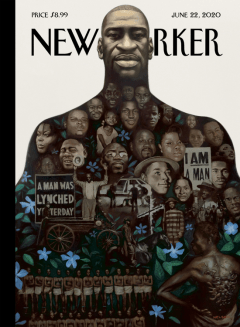
Reflections upon reading Achille Mbembe’s Necropolitics, during a week of necropolitical actions.
When I created my blog, naming it EduSpeak was a commitment to myself to continue to process various readings through the lens of education. Enter(Mgembe’s Necropolitics), start(writer’s block). Hopefully at some point, I’ll connect the dots enough to revisit this piece and make the education connections more explicit.
Following, I offer zero made sense. Perhaps due to the timing of the reading – insurrection, pandemic, precarity and reading alongside Indigenous Methodologies and Sociological Imagination – and likely because I my vocabulary and conceptualizations of the philosophies of politics are still infantile – I spend much of this reading meditating on “disembodiment,” and “transfiguration.”
I’m hoping pictures are worth more than words, as my words have failed me this week.
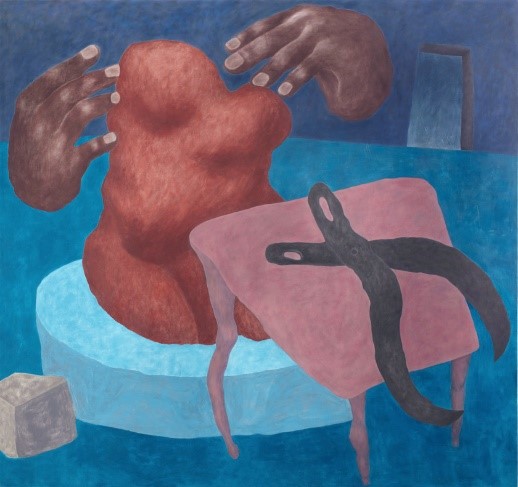
In Mbembe’s conclusion, he discusses a project of transfiguration. As this was a new word for me, I Googled, and was surprised at the dominance of Western Christian ideology attached to the word. I wanted it to read: transfiguration (v): sewing together of mind, body, and spirit – individually and collectively. Mgembe offers: “Transfiguration demands that the subject consciously embrace the broken up part of its own life; that it compel itself to take detours and sometimes improbable connections; that it operates in the interstices if it cares about giving a common expression to things that we commonly dissociate.” Even better, his definition decolonizes disembodiment and individuality, through a process of embodied awareness of self as “fragment of humanity”, a moment in “never-ending time”, and as “compound of other living beings and other species, belong(ing) to all places together.” (2019, p. 187)
His ethics of passing from place to place, “weaving with each one of them a twofold relation of solidarity and detachment. This experience of presence and distance, of solidarity and detachment, but never of indifference,” (pg. 188) elicited Mills’ description of society as a “time of uneasiness and indifference—not yet formulated in such ways as to permit the work of reason and the play of sensibility. Instead of troubles—defined in terms of values and threats—there is often the misery of vague uneasiness; instead of explicit issues there is often merely the beat feeling that all is somehow not right.” (1959, pg. 11) Democracy built on violence, requires passivity, and ignorance.
Reflecting later, Gloria Anzaldua called and said, I told you this last week, “Nepantlera represents a type of threshold person or world traveler: someone who enters into and interacts with multiple, often conflicting, political/cultural/ideological/ethnic/etc. worlds and yet refuses to entirely adopt, belong to, or identify with any single belief, group, or location.” (Keating, 2012, p. 12)
And, Nanabush, Nishnaabeg Spiritual Being and teacher, said, “Me too.” (Simpson, 2017)
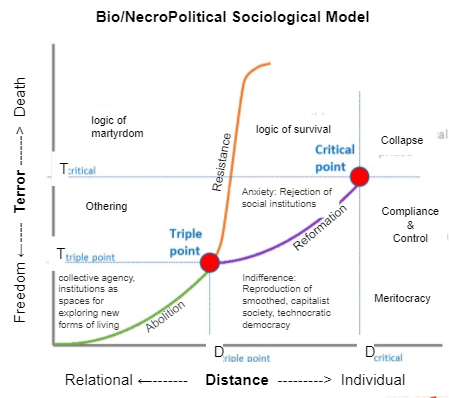
Then, the chemistry concept of phase changes jumped in my head and I spent four days searching liminality and thresholds and triple and critical point and trying to fit this to education and relationality and necropolitics and futurity. Along the way, I found this great example of speculative fiction about democratization (or not) of educational technology, and everyone should read it (Macgilchrist, 2019). The below is an attempted synthesis of that search.

 Edu-speak
One reply on “Disembodied & Alone”
Sue,
I appreciate the genuine disposition of your writing. I also thought that the content was dense and that our current condition adds yet another layer of complexity. I’m curious to hear more about the connections you’ll make between transfiguration, ethics, and education. You bring up a host of concepts that deal with an understanding of multiplicity and togetherness that would make a really interesting project in light of your interests. The image that you have selected is beautiful and pairs well with your theme of disembodiment and transfiguration.
See you in class!
LikeLike